
When people talk about the future of IoT, they almost always start in the same place. The home.
Smarter lights. Smarter thermostats. Smarter appliances. The home as a tidy box where technology can finally get its act together.
That framing made sense early on. Homes were a contained environment. A place where devices could be installed, controlled, and reset when things went wrong. If something broke badly enough, you could unplug it. You could restart the router. You could hit refresh, or reset it from the mainframe.
But the more connected our lives become, the more obvious it is that the home was never the real frontier. It was a training ground.
Our lives do not live inside four walls. Our relationships, responsibilities, work, movement, and influence extend far beyond the home, across cities, networks, organizations, and systems we do not fully control. Devices followed us out long ago. Our phones, watches, cars, headphones, badges, keys, accounts, and identities are already part of a much larger mesh.
IoT becomes truly interesting not when the home gets smarter, but when the world does.
The home as a comforting fiction
The home-centric view of IoT is comforting because it feels manageable. It implies ownership, authority, and control. Your devices. Your network. Your rules.
But it is also claustrophobic.
It assumes a clean boundary between inside and outside that no longer exists. Your phone negotiates with networks you do not own. Your car coordinates with infrastructure you cannot see. Your calendar, payments, location, and credentials interact with systems that operate on their own timelines and incentives.
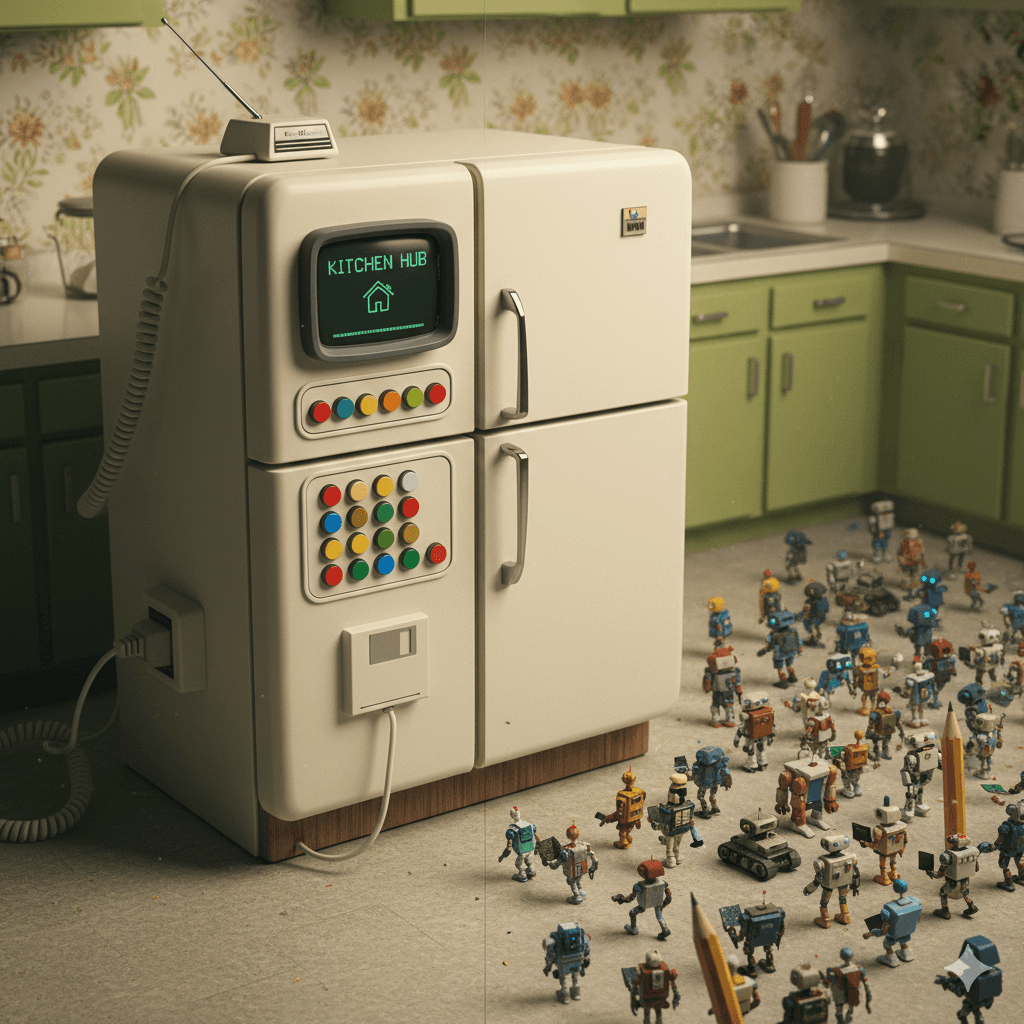
Even inside the home, this boundary has already collapsed. Cloud services decide whether your lights respond. Updates roll out on someone else’s schedule. Devices argue quietly in the background about state, timing, and priority.
The home did not get smarter. It got more crowded.
Devices are no longer stuck anywhere
The deeper shift is this. Devices are no longer anchored to a place.
They move with us. They represent us. They act on our behalf.
A phone is not just a screen. It is an identity surface. A watch is not just a sensor. It is an authority signal. A car is not just transportation. It is a mobile system negotiating right of way, energy, safety, and compliance in real time.
IoT at scale is not about where devices sit. It is about how they interact when they are not co-located, not synchronized, and not governed by a single owner.
This is where the problem space explodes.
From devices to agents with authority
Once devices begin acting for us, they stop being passive endpoints and start becoming agents.
An agent makes decisions. It retries. It escalates. It defers. It negotiates. It sometimes disagrees with other agents.
That disagreement is not a bug. It is a natural outcome of distributed authority.
Consider a simple example outside the home. A navigation system reroutes to save time. A calendar agent prioritizes a meeting. A vehicle system optimizes for safety. A work system enforces policy. All of them are acting reasonably. All of them may conflict.
Who wins. Who waits. Who yields.
Inside the home, these conflicts are annoying. Outside, they become consequential.
Latency, lag, and the cost of distance
In a closed environment, latency is mostly an engineering nuisance. Outside, it becomes a coordination problem with real consequences.
A delay in a home automation might mean a light turns on late. A delay in a mobility, logistics, or access system can mean missed opportunities, safety risks, or cascading failures.
The farther devices and agents are from each other in space, ownership, and context, the more those delays matter. Signals arrive late. Retries stack. Assumptions diverge.
The world is not forgiving in the way a living room is.
Orchestration becomes unavoidable
At small scale, coordination can be improvised. At global scale, it must be designed.
Orchestration is what allows many independent actors to behave like a system rather than a crowd. It is not about central control. It is about managing interaction.
Who is allowed to act. Who must wait. Who can override. Who is informed of failure. Who absorbs delay.
These questions were once the domain of infrastructure engineers and distributed systems researchers. They are now everyday questions for consumer-facing systems, because consumers now operate in distributed environments by default.
IoT becomes the next frontier when it stops being about connecting things and starts being about governing interaction.
Authority is the hard part
The hardest problems ahead are not technical in the narrow sense. They are questions of authority.
Which agent is allowed to act for you in which context. Which signals are trusted. Which failures are contained. Which actions can propagate.
In the home, authority feels simple. Outside, it fragments.
Your work identity is not your personal identity. Your car’s authority is not your phone’s. Your device may have permission to act in one jurisdiction and not another. Agents must negotiate these boundaries constantly.
This is not something that can be solved with better dashboards or smarter models alone. It requires a way to coordinate behavior without relying on perfect knowledge or shared semantics.
Why IoT problems return at larger scale
What makes this moment interesting is that many of these problems are familiar.
IoT has been wrestling with coordination for decades. Retry storms. Timing drift. Conflicting assumptions. Partial failure. Silent degradation.
What changes now is scale and visibility.
Agents carry more authority than sensors ever did. They trigger actions, not just readings. When they fail to coordinate, the impact is felt immediately and personally.
The same issues that once lived quietly in factories and data centers now play out in daily life, across transportation, commerce, communication, and access.
The frontier is not new problems. It is old problems that can no longer be ignored.
Beyond the walls
Thinking of IoT as a home problem limits our imagination and understates the stakes.
The real frontier is a world where devices and agents operate across environments, negotiate on our behalf, and interact under imperfect conditions. Outside is messy. But we build out AI brittle. It is quickly becoming a world where coordination matters more than raw intelligence. A world where authority must be managed carefully because it is distributed everywhere. It may be scary to think this, but this world whose tensions have been just ours for so long, no long are.
In that world, the home is just one node.
IoT becomes less about smart spaces and more about trusted interaction. Less about automation and more about alignment. Less about gadgets and more about how systems behave when no one is fully in charge.
We can no longer rely on the comfort of being able to unplug something when it misbehaves. There is no global reset button. No single mainframe to restart.
There is only coordination, designed well or designed poorly.
That is why IoT is still the next frontier. Not because our homes are changing, but because our devices, and ourselves with it, are part of it ways we werent quite before.
RELATED POSTS
AI Agents
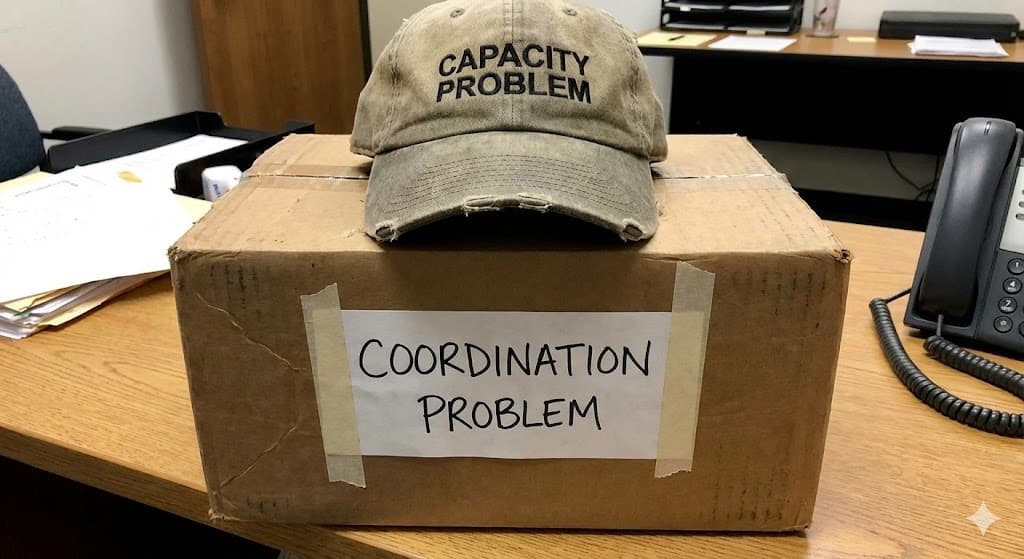
A coordination problem wearing the costume of a capacity problem
The agentic economy's infrastructure bottleneck is misdiagnosed as a capacity shortage. The actual constraint is coordination waste: agents interfering with each other through retry spirals, fanout amplification, queue contention, and blast radius expansion, converting infrastructure investment into invisible overhead. The waste fraction is not fixed but grows with agent density, meaning overprovisioning structurally breaks at scale. Historical parallel: early steam engines wasted 80-95% of energy before the flyball governor solved coordination without adding capacity. Agentic AI is in its pre-governor era. A coordination layer reading behavioral signals before waste occurs is the missing infrastructure, and the difference between the projected trillions and a very expensive bonfire.
IoT
A short, human history of the Internet of Things
How IoT went from a Coke machine at Carnegie Mellon to the most expensive unsolved problem in AI. The coordination gap that plagued connected devices for three decades never closed. Now agentic AI is hitting the same wall at higher speed and higher cost. This is the history of a problem that finally found its moment.

AI Agents
Affordances are bidirectional. We've only been listening to half the conversation.
Gibson said a cave affords shelter. He was right, but he was only hearing half the signal. The cave is also communicating outward: its geometry tells the world about the pressures that formed it and whether they are resolved. A mechanic reads the same outward signal in a car's ride. Software does it through behavioral patterns, timing drift, retry acceleration, fanout expansion, that express system state whether or not anyone is listening. We built an entire theory of affordances around what systems offer us. We ignored what they are already telling the world about themselves. The outward signal arrives first. It always has.
Tethral is just getting started.
Be the first to discover new features, integrations, and everything we’re building next.
Download Tethral for seamless control.